CORPORATE
Why the Right Unit of AI Work Is
Smaller Than You Think

QUALITARA
05.29.2026

CORPORATE
The case for narrow, production-ready POCs.
There is a question worth asking before any enterprise AI project begins: What is the one process in your business where someone, today, is doing work that an AI system could have done before lunch?
The answers are almost always specific. A team of analysts spending half their day searching documents. A 25-person intake group retyping purchase orders. An audit function that can only sample 5% of transactions and hopes the other 95% are fine. These are real costs, measurable in hours, headcount, margin, cycle time, and risk. They are also, almost without exception, solvable in less than two months.
What is striking is how rarely the conversation starts there. It usually starts with the broad strokes: an enterprise-wide AI transformation, a multi-year roadmap, a center of excellence, a platform strategy. The intent is real. The ambition is appropriate. But the framing is often the reason most of it will not ship.
The pattern is now well documented. According to Deloitte's 2026 State of AI research and S&P Global Market Intelligence, 42% of companies abandoned at least one AI initiative in 2025, with the average sunk cost reaching $7.2 million per abandoned project at large enterprises. The diagnosis is structural: enterprises are applying a project model built for predictable execution to a technology that does not behave predictably. The result is a year of work, a thoughtful roadmap, and a write-off.
And the cost is not only the money written off. It is two years of compounding advantage going to the competitor that shipped one thing in eight weeks while the steering committee was still meeting.
Where the time actually goes
The traditional enterprise project model — define the scope, sign the SOW, execute against the Gantt chart — works when the technology is well understood and the only real risk is execution. AI inverts that.
The technology is new enough, and model behavior variable enough, that the binding question is not only whether something can be built. It is whether the use case actually pays back on real data, in the real environment, at acceptable cost.
That question cannot be answered in a deck. It can only be answered by building the thing and measuring it.
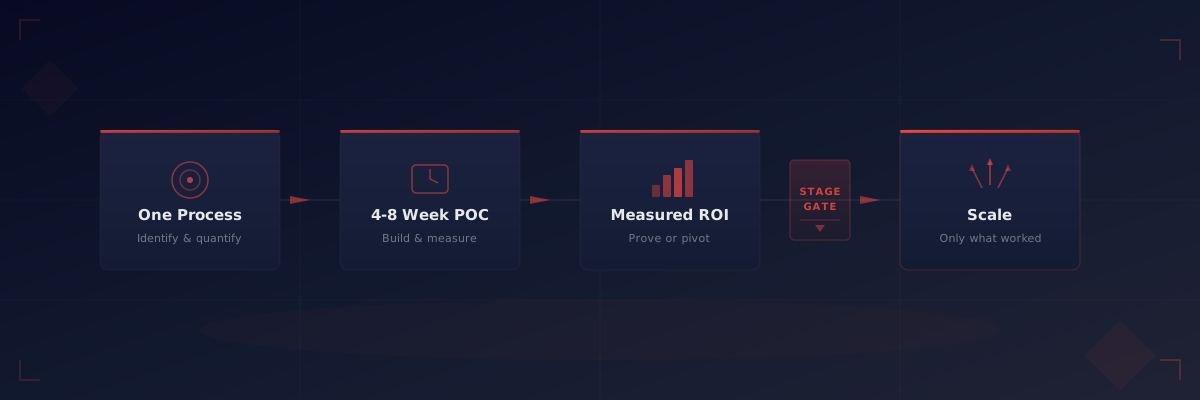
Which is why the right unit of work is not a 12-month program. It is a 4-to-8-week production-ready POC on one well-chosen wedge. Not a sandbox prototype. Not a demo disconnected from the systems where work actually happens. A working system on the client's data, in the client's stack, with the audit trail, access controls, and human-oversight points already wired in — not bolted on later. Just as importantly, the ROI baseline is agreed upfront and measured against actuals at the end.
That is the difference between an AI experiment and an AI business case.
Why narrow works
Picking the right wedge does most of the work. The patterns we see repeatedly across enterprises are narrow by nature: highly paid experts doing manual research, high-volume unstructured intake processed by hand, quality audits limited to small samples, and business leaders waiting weeks for a metric.
Each is a single, expensive process. Each can be quantified before the project starts. Each has a clear definition of success.
In one anonymized engagement with a global apparel manufacturer, the wedge was purchase order intake. A two-dozen-strong team was processing POs by hand, with lead times stretching up to 75 days. The scope was specific: ingest any PO format, extract the data, validate it, and post it to SAP. Eight weeks of work brought lead times down to two hours.
In another anonymized case, a logistics business had merged operations across three separate ERP systems and was still living with a two-week monthly close. The wedge was not a full ERP consolidation. It was a natural language query layer over the three systems, built to answer the finance team's recurring questions without forcing the business to rebuild its entire infrastructure first. The close cycle collapsed from two weeks to minutes.
What is worth noticing in both cases is that the process itself changed. The apparel team did not get a copilot to help them retype POs faster. The intake process was rebuilt so that POs in any format went through AI from the first touch. The logistics finance team did not get a faster way to reconcile three ERPs. The reconciliation step largely went away.
Fewer steps, not the same steps with AI added at the end. That distinction is where the speed and the savings actually come from.
Neither case began with a strategy deck. They began by naming one process, putting a dollar number against it, and agreeing on what would count as success before any code was written.
Stage gates instead of leaps of faith
The economic argument follows from the methodological one. A broad AI engagement front-loads cost against unproven value. The client writes a large check, waits months, and hopes the strategy survives contact with reality. The risk sits almost entirely on the buyer.
A stage-gated POC inverts that. Phase one runs four to eight weeks at fixed scope, fixed timeline, and fixed output. At the end, the buyer either has a working prototype with measured ROI, or evidence that this particular wedge is not worth scaling. Either result is useful. Both are inexpensive compared to what comes next.
Phase two is funded only if phase one earns it.
This is not a softer version of the traditional model. It is a structurally different one. The buyer never bets seven figures to find out if something works. They commit a smaller amount to find out, then scale only what already worked.
That is the operating principle behind our Solutions & AI work: start with one process, prove value under production conditions, and scale only after the economics are visible.
The discipline that compounds
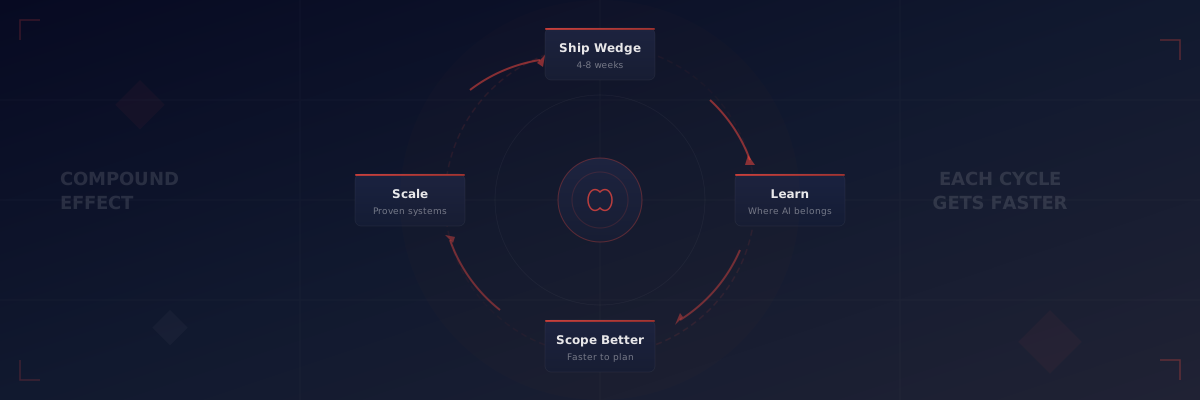
The discipline in keeping the scope limited and measurable is what compounds. Each shipped wedge teaches the organization where AI actually belongs in its operations and where it does not. Each successful POC makes the next one easier to choose, faster to scope, and safer to scale.
The roadmap that no one could draw at the start of the year writes itself, one production system at a time. The best AI roadmap is not guessed upfront. It is earned through shipped systems, measured results, and disciplined expansion.
That is the model behind Qualitara's Solutions & AI division. We embed. We prove. We build.
One wedge, eight weeks, a number we will hit or miss in front of you.
Let's map your first process.