CORPORATE
From POC to Production: Closing the
Gap That Kills Enterprise AI

QUALITARA
07.01.2026

CORPORATE
Why most AI pilots never ship — and a practical framework for making sure yours does.
The proof of concept worked. The demo impressed the steering committee. The data confirmed what everyone hoped: this particular AI use case can save the business real money, real time, real headcount. And then nothing happened.
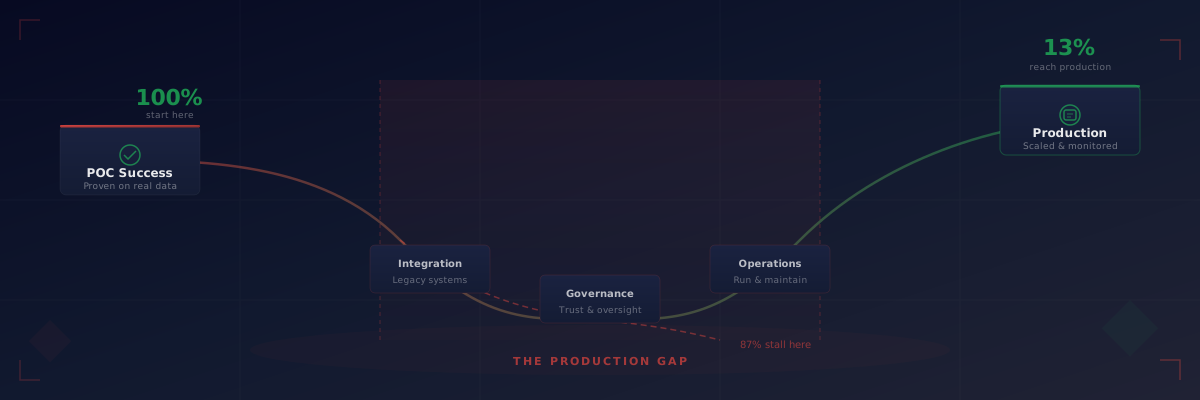
This is not an uncommon story. It is the default one. Research from Gartner and McKinsey consistently finds that fewer than 15% of enterprise AI pilots ever make it to full production deployment. The rest linger in demo environments, get quietly shelved, or restart from scratch six months later with a new vendor and the same problem.
The failure is rarely technical. The model worked. The use case was valid. What failed was the bridge between proving something works and making it operate as part of the business every single day, at scale, without constant hand-holding.
That bridge is not mysterious. It is just work that most POC engagements were never scoped to include.
The shape of the gap
A POC proves that a model can do the job. Production means the system does the job reliably, safely, within the existing IT landscape, with appropriate oversight, every day, without someone from the AI team nursing it along.
The distance between those two states is where enterprise AI goes to die. It is not one gap — it is three, and each one compounds.
The first is integration. The POC ran against a copy of the data, perhaps a CSV export or a staging database. Production means connecting to the live ERP, the document management system, the CRM, the authentication layer, the audit log — whatever already exists. These connections are never trivial. They surface edge cases the POC never encountered and constraints the vendor documentation never mentioned.
The second is governance. The POC had one user: the project team. Production means the compliance team, the legal team, and the CISO all need to sign off. Who reviews the AI's decisions? What is the escalation path when it gets something wrong? Where is the audit trail? How do you prove to a regulator that a human was in the loop? These are not optional questions. They are deployment blockers.
The third is operations. The POC was built by engineers who understand the system intimately. Production means it runs under the watch of an operations team that did not build it. They need runbooks, monitoring dashboards, alerting rules, fallback procedures, and escalation paths. Without these, the first production incident becomes the last day of the deployment.
Planning for production from day one
The mistake is not building a POC. The mistake is building a POC that was never designed to become production. The demo environment, the shortcut integrations, the manual data prep steps — all of these are fine during discovery. They become expensive liabilities the moment someone says “now scale it.”
The fix is not to over-engineer the POC. It is to scope the POC so that its outputs are production-shaped from the start. The model runs against real data, not exports. The system authenticates through the same SSO the rest of the stack uses. The decision logs write to a real audit trail, not a debug console. The human-in-the-loop is an actual workflow, not a Slack message to the project lead.
None of this requires more time. It requires different choices about where the time goes. Instead of spending week three polishing the demo UI, you spend it wiring the system into the client's identity provider and writing the first operational runbook.
That is the difference between a POC that impresses and a POC that ships.
The four-phase bridge
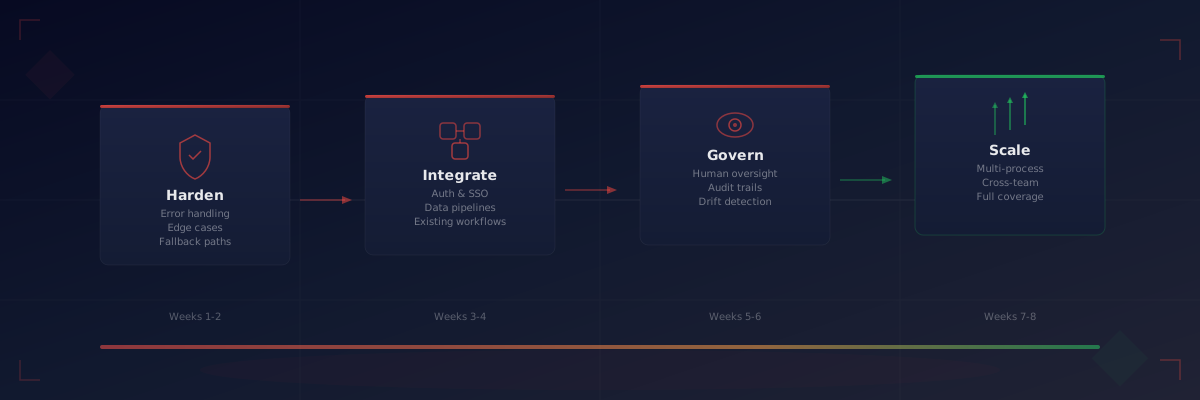
At Qualitara, we structure every AI engagement so that production readiness is built in, not bolted on. The framework has four phases, each running in parallel with the POC work rather than sequentially after it.
Harden. Every AI system encounters inputs it was not designed for. The hardening phase identifies the failure modes — malformed documents, ambiguous data, system timeouts, model hallucinations — and builds explicit handling for each. When the model cannot produce a confident answer, the system knows what to do: escalate, flag, retry, or route to a human. No silent failures. No confident wrong answers reaching the end user.
Integrate. The system connects to the real enterprise stack from the earliest possible moment. Authentication, data pipelines, downstream systems, existing workflow tools. Every integration point is a potential blocker — discovering them early means solving them while the team is still assembled and the context is fresh.
Govern. Human oversight is not a constraint. It is a feature that makes the system deployable. The governance phase defines who reviews what, how decisions are logged, what thresholds trigger escalation, and how model drift is detected over time. This is the work that gets compliance to sign off and keeps the deployment running after the first regulatory question.
Scale. Once the system is hardened, integrated, and governed for one process, the pattern repeats. The architecture is designed so that adding the second process takes weeks, not months. The monitoring infrastructure, the governance framework, the integration patterns — all of them transfer. Each subsequent deployment gets faster and cheaper.
What production actually looks like
A production AI system is not a model running in the cloud. It is an operational capability that a business team relies on every day. That means:
The operations team has a dashboard showing throughput, accuracy, latency, and error rates — not the AI team. The business owner knows exactly what percentage of decisions are automated versus escalated. There is a documented process for when the system produces an answer below the confidence threshold. Model performance is tracked weekly, and the team knows what “drift” looks like before it becomes a crisis. The system can be rolled back in minutes, not days.
None of this is revolutionary engineering. It is the same discipline that enterprises apply to any production system — databases, payment processors, customer-facing APIs. The difference is that AI teams rarely bring this mindset because the culture of AI development grew up in research labs, not operations centers.
The cost of waiting
Every week an AI system sits in a staging environment instead of production is a week of value not captured. If the POC demonstrated a 40% reduction in processing time for a team of twenty, and the production gap adds six months of delay, the business has left hundreds of thousands of dollars on the table — not because the technology does not work, but because no one planned the last mile.
Worse, momentum dies. The executive sponsor moves on. The budget gets reallocated. The team that ran the POC disbands. Six months later, a new vendor is brought in to solve the same problem, and the cycle starts again.
The antidote is not moving faster. It is scoping the work correctly from the start. A POC that includes production readiness in its timeline ships in eight weeks. A POC that defers it ships never.
That is how Qualitara approaches every Solutions & AI engagement. We do not build demos. We build systems that run in production on day one of handoff — hardened, integrated, governed, and ready to scale.
Your POC worked. Now make it real.
Let's close the gap together.